
OBSESSIO X1
Potentiometric displacement
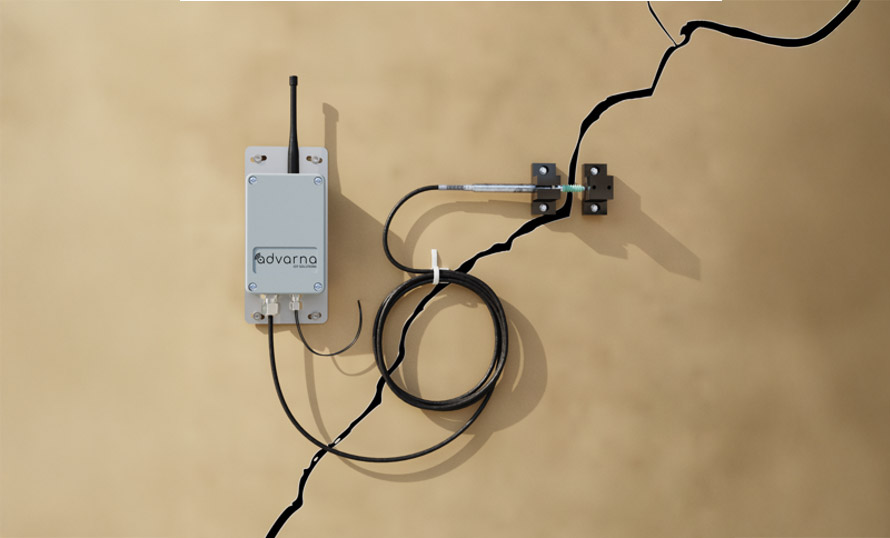
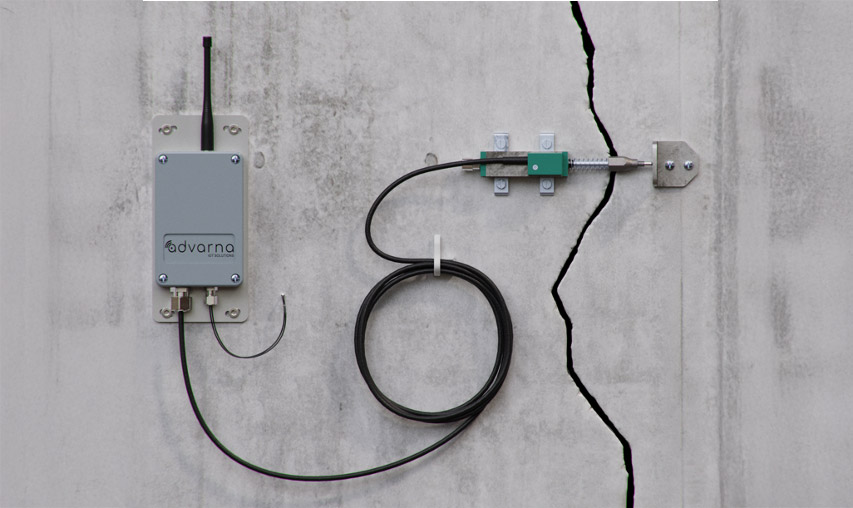
An interface for potentiometric displacement sensors, intended in particular for monitoring cracks and expansion joints. Accuracy ≤ 20 µm (module + probe).
See the product — OBSESSIO X1Monitor how cracks evolve with ADVARNA wireless crack meters, connected crack sensors that send their readings remotely. Compare the potentiometric and LVDT interfaces and the PACK FISSURE AUTONOME to prepare your instrumentation project.
A wireless crack meter is a sensor fixed on both sides of a crack that measures how its opening changes at regular intervals, according to the configured acquisition rate, and sends the readings remotely by radio (Sigfox, LoRaWAN or LoRa P2P). Unlike a crack tell-tale or a gauge read on site, it records the evolution over time without visiting the site.
Before choosing a sensor, specify the displacement to monitor, the expected stroke and the accuracy you need. Also describe the structure, the fixing points and the exposure conditions.
Potentiometric displacement
An interface for potentiometric displacement sensors, intended in particular for monitoring cracks and expansion joints. Accuracy ≤ 20 µm (module + probe).
See the product — OBSESSIO X1LVDT & potentiometric displacement
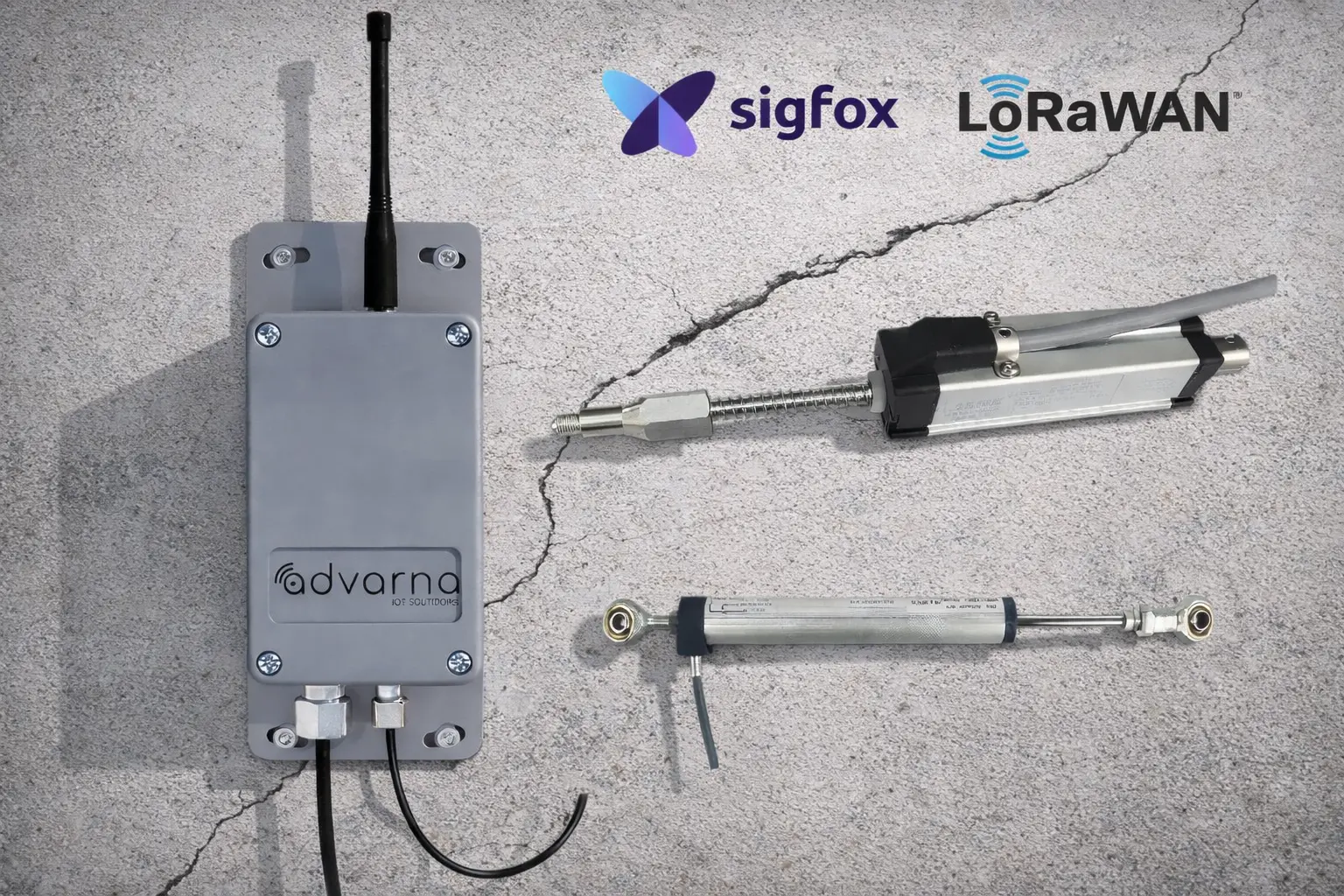
An LVDT interface, also compatible with potentiometric sensors, for monitoring cracks and structural displacements. LVDT accuracy ≤ 10 µm.
See the product — OBSESSIO X2Crack monitoring kit
A crack monitoring pack with a 25 mm or 50 mm stroke and a one-year subscription included.
See the product — PACK FISSURE AUTONOMEThe transmission options vary by product: Sigfox, LoRaWAN and, for some models, LoRa P2P. Specify the connectivity available on site and your needs for viewing, exporting data and alerts, so the proposed configuration can be checked.
Organise readings and review trends
Compare the measuring principle, the sensor stroke, the stated accuracy and what is included: OBSESSIO X1 for a potentiometric sensor (≤ 20 µm), OBSESSIO X2 for an LVDT sensor (≤ 10 µm), the PACK FISSURE AUTONOME for a kit with a MIRAN KTR2 sensor and a one-year subscription. See our comparison to prepare your choice.
Yes, a one-year Sigfox or LoRaWAN subscription is included. Contact ADVARNA for the terms after the first year.
No. The measurements track how a phenomenon evolves. Interpreting them and making decisions about the structure is the responsibility of the qualified professionals on the project.
A tell-tale (plaster or glass) only shows whether the crack has moved. A crack gauge is read by eye, on site. A wireless crack meter measures the opening at regular intervals, with an accuracy of ≤ 20 µm (OBSESSIO X1) to ≤ 10 µm (OBSESSIO X2 with LVDT), and sends the readings remotely.
Compare measurement range, accuracy, mounting, battery life and connectivity to choose a wireless crack monitor for your monitoring project.
Read the guideCompare LVDT and potentiometric sensing principles, travel, mounting and signal conditioning when planning a crack monitoring system.
Read the guideCheck the substrate, fixings, alignment, travel reserve and initial reference before starting a crack monitoring programme.
Read the guideUnderstand resolution, accuracy, repeatability and uncertainty when comparing sensor specifications and planning a measurement system.
Read the guideTell us the type of structure, the number of cracks to monitor and the measurement characteristics you need.
Capto, the ADVARNA assistant
Automatic answers, no AI
Do not write personal data in the chat. Questions asked here are recorded without personal data to improve the assistant.Your contact details are only used to handle your quote request, sent like the contact form. They are not kept in the chat. Privacy