

Several methods can be considered when monitoring a crack. Some provide a qualitative indication, while others support numerical readings or automated acquisition. The choice depends on the information required and how the observations will be used.
Manufacturers use different terminology. In this guide, “simple telltale” means a breakage indicator, “gauge” means a graduated device read on site, and “wireless crack monitor” means a measuring system that transmits data remotely. Portable digital instruments and other configurations also exist.
01 A simple telltale provides a qualitative indication
A breakage telltale installed across a crack may indicate a change when its integrity changes. By itself, that observation does not provide a numerical displacement history or establish the exact time of movement between visits.
The telltale’s condition and adhesion must also be examined. A break may require the installation to be checked before it is interpreted. This method therefore serves a limited observation purpose, to be defined with the professional responsible for monitoring. It should not be presented as a complete measurement of the structure’s behaviour.
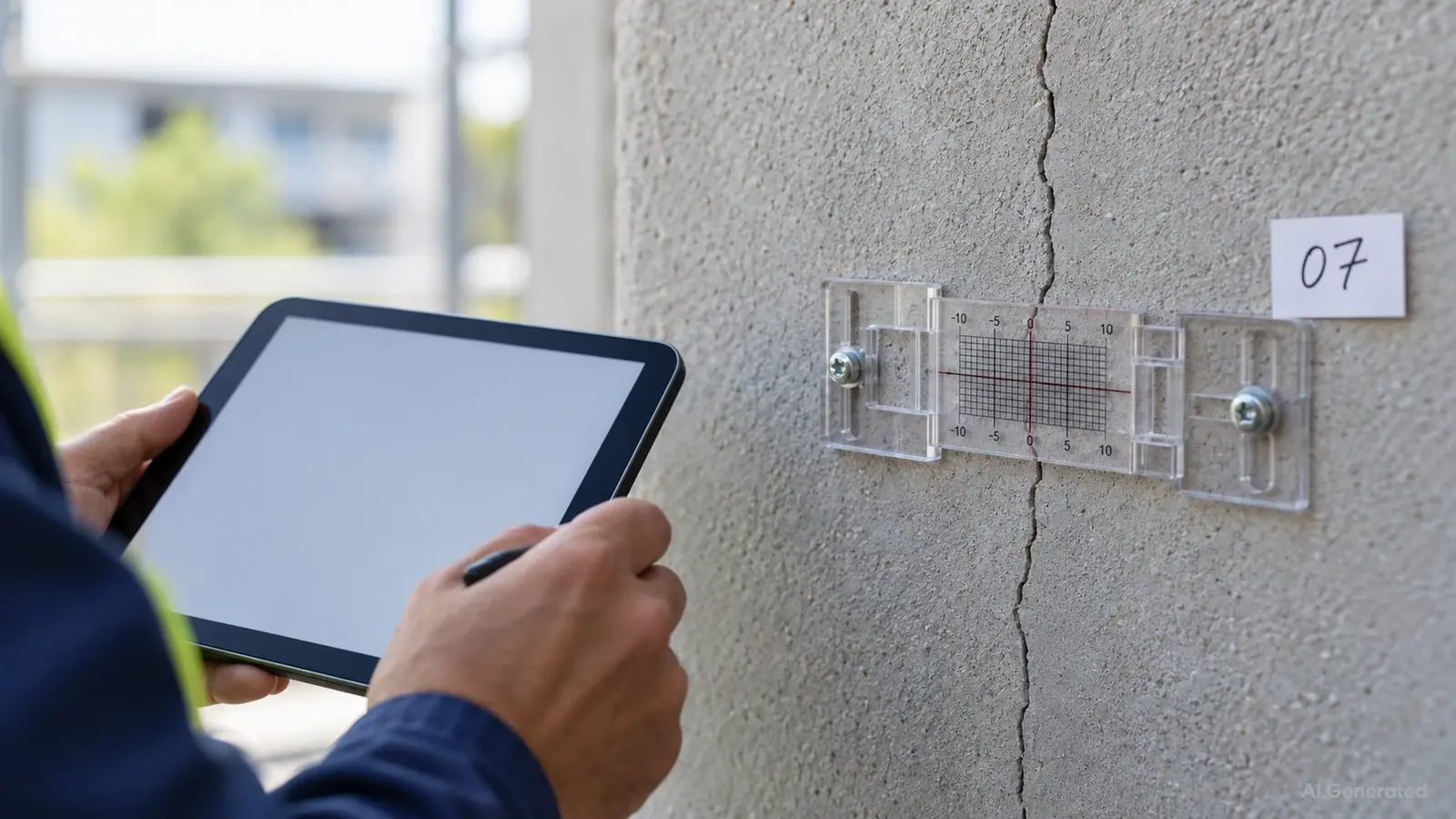
02 A graduated gauge supports on-site readings
A graduated gauge allows a position or change to be read according to its axes and design. It may suit accessible points where a programme of visits meets the project’s needs. Some gauges monitor several movement components; check the particular model. S8
The quality of the record also depends on how readings are organised: point identification, date, unit, observation conditions and data retention. Photographs can supplement a reading without necessarily replacing the manufacturer’s specified reading method. The detailed movement between visits may remain unknown.
03 A wireless crack monitor automates acquisition
A connected system combines a sensor, data acquisition and a transmission method. It may suit remote points, restricted access or readings required more frequently than planned site visits. Its value depends on the configuration actually deployed.
Check measurement and transmission intervals, radio coverage, power supply and data access. “Connected” does not automatically mean instantaneous monitoring, an operational alerting service or interpretation of results. These functions and responsibilities must be established separately.
04 Compare methods against the requirement
| Requirement | Simple telltale | Graduated gauge | Connected system |
|---|---|---|---|
| Repeated numerical observations | Does not provide a displacement series | Readings during visits | Acquisitions according to configuration |
| Site attendance | Inspection required | Reading on site | Installation and maintenance visits still needed |
| History between visits | Limited | Depends on available readings | Depends on acquisition and storage |
| Arrangements to manage | Integrity and adhesion | Reading and record keeping | Mounting, power, radio and data access |
The table describes these three categories, not the performance of every product on the market. The most suitable method produces the information needed under the project’s actual conditions.
05 Assess the cost of the whole programme
Purchase price is not enough to compare methods. Include access arrangements, travel, reading time, installation, maintenance and, where applicable, connectivity. For a small number of readily accessible points, manual readings may meet the agreed monitoring programme.
For dispersed sites or more frequent observations, automation deserves consideration. Savings cannot be promised without knowing the constraints and duration of the programme. Someone must also be responsible for reviewing the data and any unusual observations.
06 Move from requirements to a configuration
Start by defining the movement, the useful observation frequency and access conditions. Then consult our guide to choosing a wireless crack monitor if this type of solution fits the project.
The remote crack monitoring page presents the ADVARNA options. To select between models, use the OBSESSIO X1 X2 and PACK FISSURE comparison. Whatever the method, instrumented observations do not replace diagnosis and decisions by qualified professionals.
Describe my monitoring requirements