

An LVDT and a potentiometric sensor can both measure linear displacement. Their electrical principles differ, but selecting one for crack monitoring also depends on travel, mounting and the associated measurement system. The technology’s name alone cannot establish whether a configuration is suitable.
Start by describing the movement you need to follow. Our guide to choosing a wireless crack monitor sets out the requirements to define before comparing sensing technologies.
01 Understand potentiometric measurement
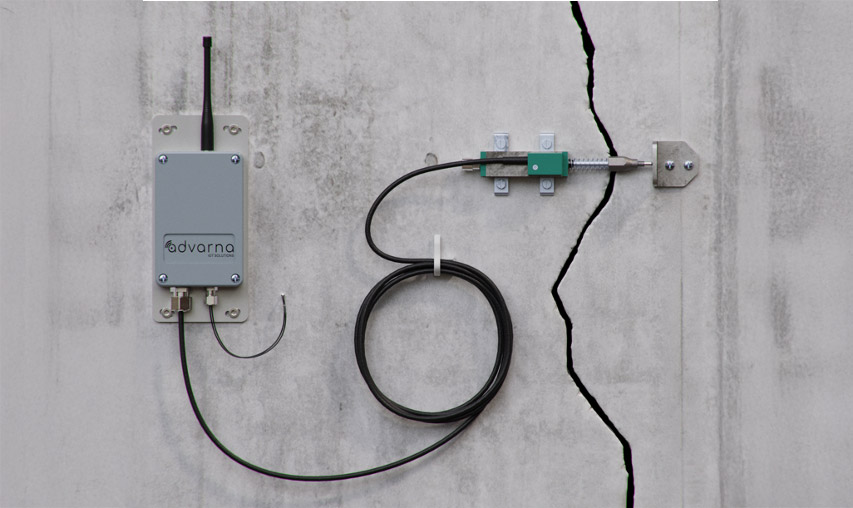
A potentiometric sensor uses a resistive track and a wiper whose position changes with displacement. With a suitable measurement circuit, the resulting voltage can be used to determine position. Acquisition electronics and wiring are therefore part of the system to assess. S7
Mechanical designs vary. Check the connection to the structure, available travel, applied force and exposure conditions for the particular model. The presence of a moving electrical contact does not establish a universal service life: this depends on the product and its use.
02 Understand LVDT measurement
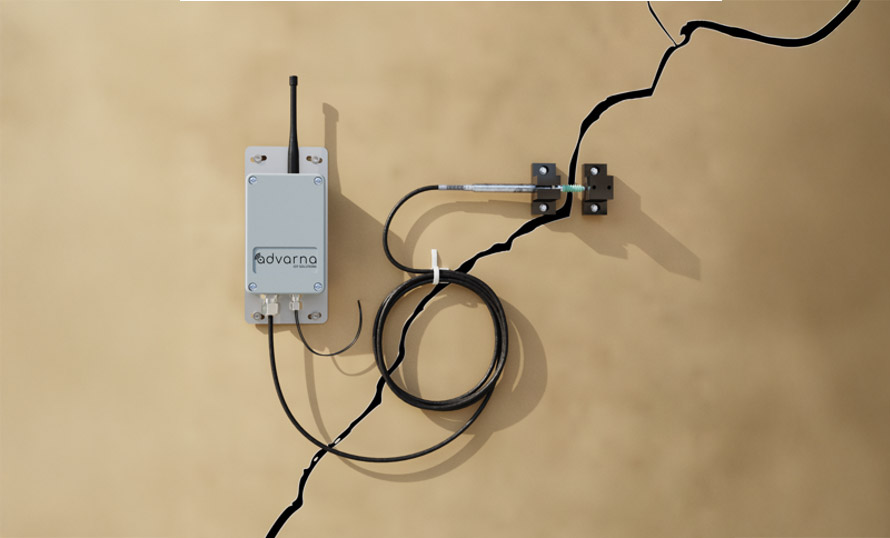
An LVDT, or linear variable differential transformer, combines coils with a moving core. As the core moves, the signals used to determine its position change. This principle requires compatible excitation and signal conditioning. S6
The absence of a sliding electrical contact in the sensing element does not mean the whole installation is contactless. Depending on the sensor, a probe or mechanical connection transfers movement from the structure to the core. Assess the actual installation rather than a simplified illustration of the technology.
03 Compare the complete measurement chain
Questions should address the assembly being supplied and its operating conditions. A selection checklist can be organised as follows:
| Criterion | What to check |
|---|---|
| Usable travel | Expected displacement and reserve in the relevant directions |
| Interface | Excitation, connections and signal processing compatible with the sensor |
| Performance | Clear identification of whether a specification covers the module, sensor or combination |
| Mounting | Fixings, alignment, force and unrestricted movement |
| Environment | Temperature, protection and exposure of each component |
Neither technology dictates a single range or performance level. Compare documented configurations using consistent units. Our article on resolution and stated measurement performance explains how to interpret these figures.
04 Avoid choosing solely by the smallest figure
A better stated performance over a short travel may not meet a requirement for greater displacement. Conversely, selecting a very large range for a small movement calls for careful interpretation of specifications expressed as a percentage of full scale.
Check whether the stated characteristics apply over the project’s temperature range. The stability of the substrate and mounting arrangement can become particularly important when small changes are being monitored. Selecting a sensing principle does not remove the need to assess installation conditions.
05 Place the ADVARNA options in context
OBSESSIO X1 interfaces with potentiometric sensors. OBSESSIO X2 provides an LVDT interface and also supports potentiometric sensors. Relevant specifications depend on the associated sensor and the configuration described in the technical datasheets.
To choose between these options and the PACK FISSURE, use the ADVARNA solution comparison. That comparison examines the products; this guide explains the sensing principles and selection questions. Transmission options must then be confirmed for the intended configuration.
06 Prepare to validate the selection
Provide the expected movement, required travel, number of monitoring points, mounting constraints and exposure conditions. If a sensor is already installed, include its reference and documentation so that compatibility can be checked rather than assumed.
Finally, describe measurement-frequency, power-supply and data-access requirements. This gives you a basis for assessing the sensor, module and installation as a complete system, with performance suited to the monitoring objective.
Discuss my sensor configuration